
Gutters, Downspouts, and Your Roof: A DFW Homeowner’s Pre-Winter Checklist
Most homeowners think about their gutters twice a year, if that. They notice them when leaves clog the corners in November, or when a hard rain sends water sheeting over the edge in a way that looks wrong. The rest of the year, gutters do their job quietly, which is exactly why they get ignored until something goes wrong.
That is a mistake in North Texas. DFW’s fall and winter pattern, long dry stretches followed by a sudden heavy rain, puts real stress on a drainage system nobody has checked since spring. And because Dallas-Fort Worth sits on expansive clay soil that shifts with moisture, a gutter problem rarely stays a gutter problem. It becomes a foundation problem, a siding problem, or a roof problem before anyone traces it back to the source.
Here is what to check before the next big rain, and how gutters connect to the roof above them and the foundation below.
Why gutters matter more than they look like they should
A gutter system has one job: collect the water coming off several hundred square feet of roof and move it away from the house in a controlled path. When that system works, water never touches the fascia, the siding, or the foundation in a concentrated way. When it fails, even quietly, all three are exposed.
The foundation piece is the one DFW homeowners care about most, and for good reason. The clay soil under most Dallas-Fort Worth neighborhoods expands when it absorbs water and contracts when it dries out. A house sitting on soil that cycles through that unevenly, because a downspout keeps dumping water in the same spot near one corner while the rest of the yard drains normally, is working against itself. Foundation movement that gets blamed on “just how old houses settle” often traces back to years of a downspout emptying a couple feet from the same footing.
The checklist
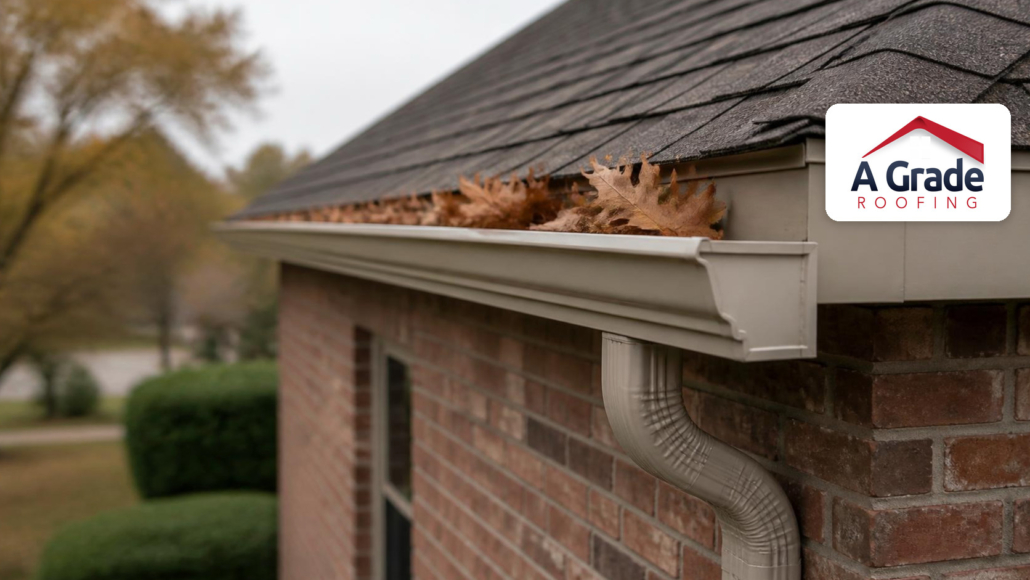
Clear every gutter and downspout. Leaves, shingle granules, and small debris collect at the low points and inside corners first. A gutter that looks fine from the ground can still be half full.
Check for sagging or pulling away from the fascia. Gutters hang on brackets spaced along the fascia board. When those brackets loosen, or the fascia behind them softens from years of standing water, the whole run starts pulling down and away from the roofline. This is one of the more common findings on a fall roof inspection, and it usually means water has been getting behind the gutter for a while.
Follow every downspout to where it actually empties. A downspout that dumps water a few feet from the house is doing part of the job. One that empties directly against the foundation, or into a splash block that has shifted out of position, is undoing it. Extensions are simple to add where they are missing.
Look for granules collecting in the gutter. Asphalt shingles shed granules as they age, and a build-up in the gutter trough is one of the more reliable early signs that a roof is further into its life than it looks from the ground. Worth mentioning to whoever checks the gutters, since it points back to the roof itself.
Check flashing where the roofline meets a wall, chimney, or dormer. These transitions are common leak points, and a fall walk-through is a good time to look for lifted or cracked flashing before winter rain finds it.
Look at valleys and any low-slope sections for standing debris. Water that cannot reach a gutter because a valley is packed with leaves finds another way off the roof, and that way is usually not the one the roof was designed for.
Consider gutter guards if leaf and debris buildup is a recurring problem. They do not eliminate maintenance, but they cut down how often gutters need to be cleared by hand, especially on a lot with mature trees overhanging the roofline.
What a backed-up gutter does to the roof
The part most people miss is that a clogged gutter is a roof problem before it is a drainage problem. Leaves land on the roof first, slide into the valleys and the gutter trough, and pack down with the first rain. Once the gutter is full, the water coming off the roof has nowhere to go. It rises in the trough, backs up under the drip edge and the first course of shingles, and soaks the decking and the fascia behind the gutter. That is where a lot of “mystery” ceiling stains near an exterior wall come from in November: not a hole in the roof, but water that could not escape.
The same thing happens in a valley packed with leaves. Water that should be running down the valley to the gutter pools against the debris and finds the seams instead. Clearing the roof surface and the valleys is part of the job, not just the gutters, and it has to happen every fall in DFW, because the trees drop a new load right as the rain comes back.
Hail and gutters
Gutters are metal, and metal dents. After any hail event in DFW, gutters and downspouts are often the first place damage shows up, sometimes before anyone confirms whether the shingles themselves took a hit. Dented gutter runs, especially on the side of the house that faced the storm, are worth photographing and documenting the same way roof damage is, since both may end up on the same insurance claim.
Signs it is time for a professional look
A few findings are worth a call rather than a DIY fix: gutters visibly pulling away from the house along more than a short section, water staining on the fascia or soffit underneath a gutter run, a downspout separated at a joint, or granule buildup heavy enough to see without climbing anything. Any of these can be a symptom of a roof problem rather than a gutter problem on its own, which is why gutters belong inside a full roof inspection rather than off to the side as a separate item.
Where A Grade fits
A Grade Roofing inspects residential and light-commercial roofs across Dallas-Fort Worth, and gutters, flashing, and drainage are part of that inspection, not an afterthought. If a hailstorm has come through your neighborhood, or you simply have not had anyone look at the roofline since last spring, a fall review catches the small things before the next heavy rain turns them into bigger ones.
Call 214-663-1116 or request a free roof review at agradetexas.com before the season’s first real rain arrives.


